Focus Keyword
breast cancer molecular switch VIPR2
H2 Section Headings
- What Is VIPR2 and Why Does Overexpression Matter in Breast Cancer
- How Receptor Dimerization Amplifies Cancer Signaling
- The TM3-4 Peptide: A Molecular Switch That Breaks the Dimer
- What the Experiments Showed in Cell and Animal Models
- Why VIPR2 Dimerization Is a Viable Drug Target
- Next Steps: Purified Peptides, Animal Studies, and the Path to Clinical Translation
Researchers at Hiroshima University have identified a molecular mechanism through which a protein receptor drives breast cancer growth and metastasis — and demonstrated that small chains of amino acids can disrupt that mechanism, suppressing tumor progression in cell and animal models. The findings, published in the British Journal of Pharmacology (DOI: 10.1111/bph.70039), center on vasoactive intestinal peptide receptor-2 (VIPR2), a receptor that under normal conditions regulates circadian rhythm, immune function, and insulin release, but becomes a driver of cancer when overexpressed in breast tissue.
Breast cancer's capacity to spread beyond its original site — a process called metastasis — remains one of the central challenges in oncology. Surgical removal of a primary tumor does not eliminate cells that have already migrated to lymph nodes or distant organs. Understanding the molecular signals that enable those cells to proliferate and travel is a prerequisite for developing treatments that can intercept the process. The Hiroshima team's work identifies one such signal and proposes a class of molecules that could potentially block it.
The research was led by co-corresponding authors Satoshi Asano, assistant professor, and Yukio Ago, professor, both in the Department of Cellular and Molecular Pharmacology at Hiroshima University's Graduate School of Biomedical and Health Sciences. Funding was provided by the Japan Society for the Promotion of Science, the Japan Agency for Medical Research and Development, the Hiroshima University Fund Nozomi H Foundation, and the Tokyo Biochemical Research Foundation.
What Is VIPR2 and Why Does Overexpression Matter in Breast Cancer
VIPR2 is a G protein-coupled receptor that binds to vasoactive intestinal peptide (VIP) and pituitary adenylate cyclase-activating polypeptide (PACAP). In healthy tissue, the receptor participates in a range of physiological processes including the regulation of the body's internal clock, modulation of immune responses, and control of insulin secretion from the pancreas. Its broad role in normal physiology makes it a therapeutically sensitive target — interventions must be precise enough to disrupt its cancer-promoting functions without compromising its normal ones.
Problems arise when cells produce excessive quantities of VIPR2. At elevated concentrations, the receptor accelerates breast cancer cell division and enhances the cancer's ability to invade surrounding tissue and travel to new sites in the body. High VIPR2 expression has been correlated with more aggressive tumor behavior. At these elevated levels, the receptor also acquires an additional property: it can bind to a second copy of itself, forming a paired structure known as a homodimer.
How Receptor Dimerization Amplifies Cancer Signaling
Many protein receptors can pair with identical molecules through a process called homodimerization. When two receptor units combine, the resulting dimer can exhibit different binding properties and trigger different downstream signaling cascades compared with a single receptor unit, known as a monomer. Whether VIPR2 undergoes direct homodimerization — and what functional consequences that pairing has specifically in breast cancer cells — had not previously been established.
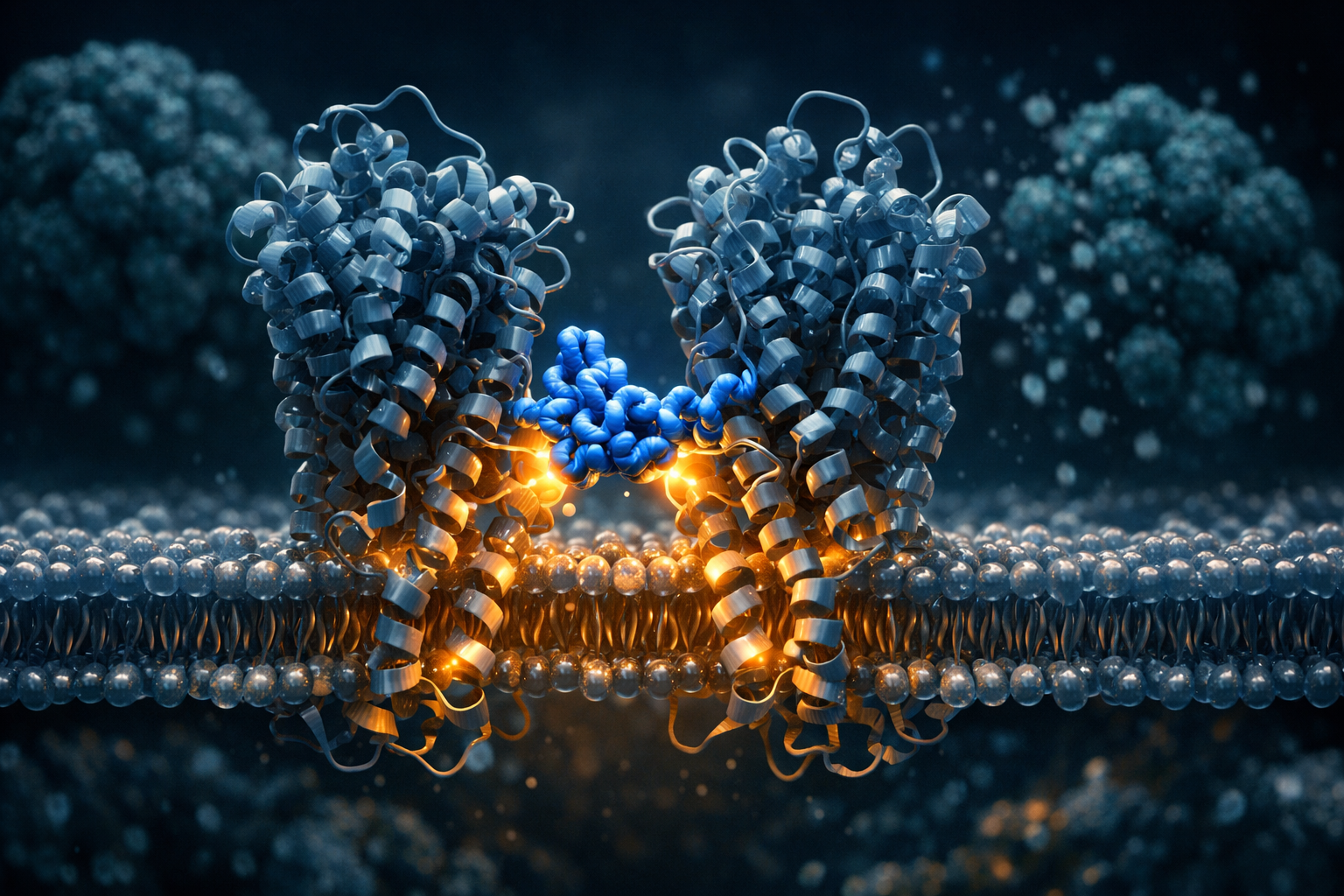
The Hiroshima team first confirmed through direct experimental measurement that VIPR2 molecules can physically connect with each other to form homodimers. They then used both cell-based assays and a mouse model to map the consequences of that pairing. Their results showed that dimerized VIPR2 promotes tumor growth and lymph node metastasis. The dimerization occurs through specific regions of the receptor known as transmembrane domains 3 and 4 (TM3 and TM4) — the structural segments that span the cell membrane. These domains control both the stability of the receptor pair and its ability to activate cancer-promoting signaling pathways.
VIPR2 de-dimerized by expression of TM3-4 had reduced affinity for specific proteins and was no longer involved in the activation of signaling pathways involved in cell proliferation and metastasis.
— Yukio Ago, Professor of Cellular and Molecular Pharmacology, Hiroshima UniversityThe TM3-4 Peptide: A Molecular Switch That Breaks the Dimer
The key experimental finding involves small chains of amino acids derived from the TM3 and TM4 regions of VIPR2, designated TM3-4 peptides. These peptides interfere with the way the two transmembrane domains interact with each other, preventing the receptor units from pairing. When cells expressed TM3-4 peptides, the VIPR2 molecules moved further apart — a result the researchers interpreted as evidence that the peptides disrupt homodimerization directly.
Breast cancer cells stably expressing TM3-4 showed suppressed tumor growth and reduced lymph node metastasis in the experimental models tested. The de-dimerized VIPR2 receptor displayed reduced affinity for the proteins it normally recruits — including the Gαi signaling protein — and was no longer capable of activating the downstream pathways that drive cell proliferation and invasion. The process of breaking apart the dimers is referred to by the researchers as de-dimerization, and TM3-4 peptides are the agents that accomplish it.
What the Experiments Showed in Cell and Animal Models
The research team's experimental approach combined molecular imaging, receptor binding assays, and in vivo tumor models to build a mechanistic picture of VIPR2 dimerization and its consequences. In cell-based experiments, the team demonstrated that VIPR2 homodimers enhance the receptor's affinity for VIP and for the Gαi protein — a component of the intracellular signaling machinery that, when activated, promotes cell proliferation and survival. Dimerization effectively amplifies the receptor's signaling output in response to the same ligand concentration.
In the mouse model, breast cancer cells stably expressing TM3-4 peptides showed measurably suppressed tumor progression and reduced metastasis to lymph nodes compared with control cells. The finding establishes a direct functional link between VIPR2 dimerization and tumor biology in a living organism, moving the result beyond a cell culture observation. The authors note that these statistics are not yet sufficient to conclude clinical efficacy, but they provide the mechanistic and preclinical rationale for advancing toward purified peptide testing.
"Since the expression of TM3-4 was able to suppress the progression of breast cancer cells, we plan to verify the anticancer effect of the purified TM3-4 peptide in animal models. Our goal is to develop novel anticancer drugs that target cancer cells in which dimerization is enhanced due to increased expression of VIPR2."
Why VIPR2 Dimerization Is a Viable Drug Target
Receptor dimerization as a drug target is an established but still developing area of oncology pharmacology. The concept is that disrupting the physical pairing of receptor units — rather than blocking the receptor's ligand-binding site directly — offers a different mechanism of action that may be less susceptible to the resistance mutations that frequently undermine conventional receptor antagonists. Because the TM3-4 peptides act at the receptor-receptor interface rather than at the hormone-binding site, they represent a structurally distinct class of potential therapeutic agent.
The VIPR2 system is notable because the receptor's normal physiological roles are broad, which complicates systemic blockade approaches. A de-dimerization strategy that specifically targets the overexpressed, dimerized form of the receptor — which is the form predominantly found in aggressive breast cancer cells — could offer greater tumor selectivity than approaches that inhibit all VIPR2 activity regardless of oligomeric state.
Next Steps: Purified Peptides, Animal Studies, and the Path to Clinical Translation
The current study used genetically expressed TM3-4 peptides rather than purified, exogenously administered compounds. The next phase of research, as outlined by the Hiroshima team, involves verifying the anticancer effect of purified TM3-4 peptide administered as a drug-like molecule in animal models. This step is necessary to assess pharmacokinetics — how the peptide is absorbed, distributed, and cleared — as well as toxicity and therapeutic window before any consideration of human trials can begin. The team's stated goal is the development of novel anticancer drugs targeting VIPR2 dimerization in tumors where the receptor is overexpressed.
The full study, Dimerisation of the VIP receptor VIPR2 is essential to its binding VIP and Gαi proteins, and to its functions in breast cancer cells, by Satoshi Asano, Kairi Ozasa, Teru Uehara, Rei Yokoyama, Takanobu Nakazawa, Souichi Yanamoto, and Yukio Ago, was published on 9 April 2025 in the British Journal of Pharmacology and is available open access at doi:10.1111/bph.70039.
💬 Comments (0)
No comments yet. Be the first to share your thoughts.
Leave a Comment